Seamless imaginaries, territorialized realities: the regional politics of corridor governance in Southern Africa

New article out in Territory, Politics, Governance
Abstract
Corridors are central to contemporary processes of spatial reordering. On the African continent, they feature prominently in development planning at national, regional and continental scales. This article sheds light on the regional politics and supranational governance of cross-border corridors, aspects that have remained underrepresented in the burgeoning literature on corridors. Combining theoretical insights from the New Regionalism Approach and critical political geography and focusing on the ‘corridor agenda’ pursued by the Southern African Development Community (SADC), the article deconstructs dominant conceptions of corridors as archetypal spaces of flow and advances the argument that the spatial production and governance of cross-border corridors are contingent upon the compatibility of scalar and territorial articulations of state space. In the case of the Walvis Bay–Ndola–Lubumbashi Development Corridor, the incompatibility of Namibia’s decidedly regional ‘gateway strategy’ and Zambia’s (sub)national ‘pothole politics’ has yielded a connectivity patchwork. Efforts to institutionalize supranational corridor governance have been obstructed by state territoriality aimed at retaining political control over corridor space at the national scale. While commonly represented as spatial panaceas for attaining neoliberal meta-goals of global connectivity and seamless territorial integration, (trans)regional corridors are politically contested spaces that engender dialectical processes of de- and reterritorialization at various scales.
Link to full text

‘Win-win’ contested: negotiating the privatisation of Africa’s Freedom Railway with the ‘Chinese of today’

New article out in the Journal of Modern African Studies

Abstract

As infrastructure development has become a key ingredient in Africa–China relations, the role of African governments in co-determining the design, funding and governance of the continent’s infrastructures has come under close scrutiny. This article sheds light on the rehabilitation of a symbol of Sino–African friendship: the Tanzania–Zambia Railway Authority (TAZARA). Employing Jessop’s strategic-relational approach, it is shown that the strategies of the shareholding governments in the negotiations with a Chinese consortium were informed by strategic learning from previous railway privatisations, corresponding cost–benefit analyses and reflection about Chinese commercial interests. Zambia’s indebtedness and Tanzania’s autocratic developmental state under President Magufuli formed crucial elements of the structural context in which the fate of Africa’s Freedom Railway was negotiated. The article transcends both crudely structuralist accounts of a supposedly all-powerful China and voluntarist conceptions of African agency that are void of structure. Assessing (African) agency requires analytical sensitivity towards the dialectical interaction between specific strategic capacities and strategically selective political–economic contexts.

Link to full text

Infrastructure and the Politics of African State Agency: Shaping the Belt and Road Initiative in East Africa

New article, co-authored with Frangton Chiyemura and Elisa Gambino, in Chinese Political Science Review

Abstract

Infrastructure development has experienced a political renaissance in Africa and is again at the centre of national, regional, and continental development agendas. At the same time, China has been identified by African policy-makers as a particularly suitable strategic partner. As infrastructure has become a main pillar of Sino-African cooperation, there has been growing analytical interest in the role of African actors in shaping the terms and conditions and, by extension, the implementation of infrastructure projects with Chinese participation. This follows a more general African “agency turn” in China–Africa studies, which has shifted the research focus onto the myriad ways in which African state and non-state actors shape the continent’s engagements with China. This article is situated within this growing body of literature and explores different forms of African state agency in the context of Tanzania’s planned Bagamoyo port, Ethiopia’s Adama wind farms, and Kenya’s Lamu port. We posit a non-reductionist and social-relational ontology of the (African) state which sees the state as a multifaceted and multi-scalar institutional ensemble. We show that the extent and forms of state agency exerted are inherently interrelated with and, thus, highly contingent upon concrete institutional, economic, political, and bureaucratic contexts in which African state actors are firmly embedded. In doing so, we make the case for a context-sensitive analysis of various spheres of state agency in particular conjunctures of Sino-African engagement.

Link to full text

Railway Imperialisms in East Africa: Laying the Tracks for Exploitation

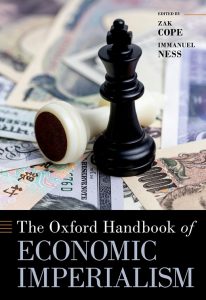
New chapter out in The Oxford Handbook of Economic Imperialism, edited by Zak Cope and Immanuel Ness

Abstract
Physical infrastructure has been central to the century-long exploitation of Africa’s soil and peoples by external powers. This chapter sheds light on the pivotal role of railways in the political economies of historical and contemporary imperialisms in East Africa. It first recounts how rail infrastructure developments in Britain’s East Africa and Uganda Protectorates as well as in German East Africa fostered colonial primitive accumulation by forcing local and imported labour power to construct the means that would accelerate the theft of the continent’s natural wealth. In a second step, the chapter examines how contemporary infrastructure development in the region has continually served economic imperialisms. China’s transition from a provider of anti-imperial infrastructure, in the form of the Tanzania-Zambia Railway Authority (TAZARA), to a neo-imperial investor is problematized in the context of East Africa’s gradual integration into the Belt and Road Initiative (BRI). Drawing on David Harvey’s theorization of spatio-temporal fixes as a tendency inherent to capitalist imperialism, the chapter documents how debt-financed large-scale infrastructure projects, such as Kenya’s new Standard Gauge Railway, serve the geographical expansion of Chinese surplus capital and lock the region into Chinese-centred systems of accumulation. The chapter concludes that Africa’s contemporary infrastructure boom perpetuates the continent’s dependent integration into the global capitalist economy and facilitates new forms of accumulation by dispossession.

Link to full text

Debt, distress, dispossession: towards a critical political economy of Africa’s financial dependency

New article in the Review of African Political Economy

Abstract
With China’s rise to become Africa’s largest bilateral creditor, much research has focused on an evidence-based critique of the politicised narrative about China’s supposed ‘debt trap diplomacy’. At a more fundamental level, this debate problematises the function of debt and related power differentials in late capitalism and calls into question development paradigms, notably the hegemonic infrastructure-led development regime, that have sustained Africa’s financial dependency into the 2020s. As the International Monetary Fund is yet again shuttling between Addis Ababa, Lusaka, and Nairobi to resurrect fiscal discipline and to ensure debtor compliance for the post-pandemic ‘payback period’, it is argued that (i) periodic cycles of debt financing, debt distress and structural adjustment are a systemic feature of the malintegration of Africa into the global capitalist economy, and (ii) critical research on the social costs and economic beneficiaries of renewed rounds of austerity and privatisation in Africa’s current debt cycle is needed.

Link to full text

Capitalism and Africa’s (infra)structural dependency: A story of spatial fixes and accumulation by dispossession

New chapter, co-authored with Ian Taylor, in Africa and the Global System of Capital Accumulation, edited by Emmanuel O. Oritsejafor and Allan D. Cooper

Abstract
Instead of expediting “Africa’s transformation”, as suggested by the Programme for Infrastructure Development in Africa (PIDA) of the African Union (AU) (PIDA, n.d.), this chapter argues that the recent upsurge in infrastructure development has reinforced the continent’s dependency on external actors and fosters patterns of accumulation by dispossession. We are helped by David Harvey’s theory of spatio-temporal fixes and the key functions it attributes to infrastructure and debt in the global system of capital accumulation. The chapter proceeds in four stages. The chapter first briefly recounts Harvey’s concepts of the spatio-temporal fix and accumulation by dispossession. In a second step, we contextualize Africa’s recent infrastructure boom and situate it against the wider saga of “Africa rising.” The third part of the chapter scrutinizes China’s rise as the continent’s new “infrastructure giant” and problematizes particularities of the “Chinese infrastructural fix” in Africa. The chapter then concludes by extrapolating some trends that we believe will become increasingly relevant in Africa’s infrastructure sector and that underline the enduring function of infrastructure as “means of dispossession” (Cowen 2017).

Link to full text

China’s spatial fix and ‘debt diplomacy’ in Africa: constraining belt or road to economic transformation?

New article, co-authored with Pádraig Carmody & Ian Taylor, in the Canadian Journal of African Studies

Abstract

Mounting overaccumulation of capital and material has compelled the Chinese government to seek solutions overseas. The Belt and Road Initiative (BRI), with its transregional infrastructure projects connecting Eurasia and Africa, is the hallmark venture in this effort. Chinese road, railway, port and energy projects, implemented under the BRI banner, have become widespread in Africa. This article traces drivers of the BRI in the post-reform evolution of the Chinese economy and conceptualises the BRI as a multi-vector “spatial fix” aimed at addressing chronic overaccumulation. Focusing on Kenya, Djibouti and Ethiopia, the paper documents how loan financing related to BRI projects reveals contradictions that arise from China’s spatial fix in Africa. Concerns about a looming debt crisis on the continent and the questionable economic sustainability of some BRI projects have become more pressing amidst the COVID-19-induced economic contraction. Hopes for Africa’s economic transformation based on increasing connectivity under the BRI are unlikely to materialise.

Link to full text

The Chinese infrastructural fix in Africa: Lessons from the Sino-Zambian ‘road bonanza’

New article out in Oxford Development Studies

Abstract

This article scrutinises the surge in Chinese-funded road development in Zambia with the help of David Harvey’s theory of spatio-temporal fixes. The ‘moving out’ of Chinese surplus capital and material to Africa has been facilitated by an extensive disbursement of loans and export credits for infrastructure projects. Transcending Harvey’s analytical ‘imperio-centrism’, the article shows that the actualisation of the Chinese infrastructural fix has been contingent upon Zambia’s ambitious, debt-financed infrastructure development agenda. Particularities of Chinese loan financing have thereby fostered ‘not so public’ procurement processes and accelerated Zambia’s rapid debt accumulation. As rising debt has imposed structural constraints, the recent shift in the financial governance of road development towards private project finance is analysed with reference to the Lusaka-Ndola dual carriageway. The renaissance of public-private partnerships and the gradual privatisation of Zambian roads signify new rounds of accumulation by dispossession, as the Chinese infrastructural fix enters its next stage.

Link to full text

In a fix: Africa’s place in the Belt and Road Initiative and the reproduction of dependency

Co-authored with Ian Taylor

South African Journal of International Affairs 27(3): 277-295

The Belt and Road Initiative (BRI) aims to integrate Africa into an ambitious Chinese-constructed infrastructure network. The terms of this integration however deepen Africa’s dependent position and perpetuate its terms of (mal)integration into the global political economy. These terms, which are characterised by external domination and socially-injurious and extraverted modes of accumulation, are likely to be exacerbated by the BRI’s focus on facilitating extraction from the African continent while importing huge amounts from China. While the BRI aims to resolve contradictions within China’s own economy, the latent dynamics within the BRI vision may result in an entrenched African dependency.

Link to article